Summer 2016 schools on algorithms, optimization, scheduling, and other relevant #orms topics

There is a lot going on this Summer (or Winter, if you head to Brazil). I have compiled a list of schools that seem very interesting for those who like algorithms, optimization, and related topics. Some have no registration available yet. The deadline for two of them are over and for a few others it is approaching. However, because some of those are (or could be) recurrent, I felt that listing them would be useful if someone reads this in the future.

International Summer School on Autonomous Agents and Multiagent Systems
May 6-8     (deadline: April 15)
Singapore

4th International Symposium on Combinatorial Optimization (ISCO) Spring School
May 19-20     (deadline: April 12)
Salerno, Italy
* Included on March 10 by suggestion of Martim Joyce-Moniz and Daniel Oliveira

117th European Study Group with Industry
May 23-27     (deadline: May 27)
Avignon, France
* Included on March 10 by suggestion of Martim Joyce-Moniz

Integer Programming and Combinatorial Optimization (IPCO) 2016 Summer School
May 30-31     (deadline not posted yet)
Liège, Belgium

Eötvös Loránd University Summer School in Mathematics: Discrete algorithms and applications
June 6-10     (deadline: May 31)
Budapest, Hungary

COST/MINO PhD School on Advanced Optimization Methods 2016
June 6-10     (deadline: May 13)
Rome, Italy
* Included on April 7

International Conference on Automated Planning and Scheduling (ICAPS) Summer School
June 8-11     (deadline: March 18)
London, UK

Numerical Computations: Theory and Algorithms (NUMTA) International Conference and Summer School
June 19-25     (deadline: March 10 for regular fee)
Calabria, Italy

Association for Constraint Programming (ACP) Summer School 2016
June 20-24     (deadline: May 20)
Cork, Ireland

Mixed Integer Non-Linear Programming (MINLP) School: Theory, algorithms and applications
June 20 – July 1     (deadline was February 20)
Sevilla, Spain

Satisfiability (SAT), Satisfiability Modulo Theories (SMT), and Automated Reasoning (AR) Summer School
June 22-25     (deadline not posted yet)
Lisbon, Portugal

2016 Summer School on Real Algebraic Geometry and Optimization
July 11-15     (deadline was April 1st)
Atlanta, GA, United States
* Included on June 9 by suggestion of Akshay Gupte

2016 Industrial Math/Stat Modeling Workshop for Graduate Students
July 17-27     (deadline: April 15)
Raleigh, NC, United States
* Included on March 20

São Paulo School on Algorithms, Combinatorics, and Optimization
July 18-29     (deadline: March 28)
São Paulo, Brazil

12th Multipe Criteria Decision Aid and Multiple Criteria Decision Making (MCDA/M) Summer School
July 18-29     (deadline was December 30)
Recife, Brazil

Argonne Training Program on Extreme-Scale Computing
July 31 – August 12     (deadline: March 25)
St. Charles, IL, United States

Prague Summer School on Discrete Mathematics 2016
August 1-5     (deadline: March 31)
Prague, Czech Republic

3rd Algorithmic and Enumerative Combinatorics (AEC) Summer School 2016
August 1-5     (deadline: June 15)
Hagenberg, Austria

Institute for Mathematics and its Applications (IMA) Program on Mathematical Optimization
August 1-12     (deadline not posted)
Minneapolis, MN, United States
* Included on March 10 by suggestion of Jeff Linderoth
* Website link added on March 14

Statistical and Applied Mathematical Sciences Institute (SAMSI) Optimization Program Summer School
August 8-12     (deadline: June 8)
Raleigh, NC, United States
* Included on March 24 by suggestion of Sercan Yildiz

Algorithmic Optimization Autumn School
September 19-22     (deadline: August 21)
Trier, Germany
* Included on May 10

What does an INFORMS Student Chapter do? A 2015 review at Carnegie Mellon University

(Originally posted at the CMU INFORMS website).

Our annual report to INFORMS was due yesterday. What a year! After compiling everything we did, it would be a waste not to share it more publicly. Except for the chapter and fora breakfast at the INFORMS Annual Meeting, we don’t know much of what happens elsewhere.

The big things

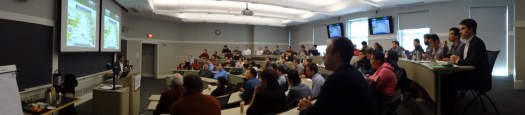
We had two major events in 2015. Thanks to sponsorship from the Tepper School of Business, we had a seminar and a tutorial with MIT students Joseph Huchette and Miles Lubin: “JuMP, a modeling language for mathematical optimization”. We also had a happy hour followed by an ORMS job market panel with alumni that were in Pittsburgh to attend the ISMP 2015 conference. The panelists included Amitabh Basu, Fatma Kilinc-Karzan, Qihang Lin, Marco Molinaro, Selvaprabu Nadarajah, Viswanath Nagarajan, and Negar Soheili.
alumni

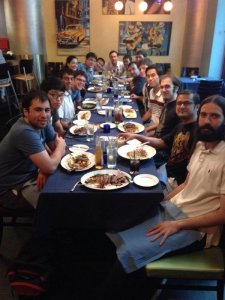
Among our social gatherings, we had a joint happy hour with the University of Pittsburgh chapter:
pitt
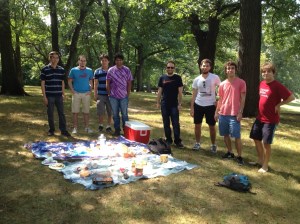
Besides that, we had two “pizza social” events to talk about what the chapter could do and a picnic on our elections day, which also served to welcome the incoming PhD students:
picnic

Our (short) history

The Carnegie Mellon University INFORMS Student Chapter is quite young. In fact, I still remember Alex Kazachkov going down the hall asking which students were INFORMS members to submit the chapter application, aiming to bring to CMU something that meant a lot to him as an undergrad in Cornell. We took off in June 2014 gathering students from the doctoral programs in ACO (Algorithms, Combinatorics, and Optimization), OM (Operations Management), and OR (Operations Research) at CMU’s Tepper School of Business, which together account for 24 students (about 4-5 students per year). With time we also attracted students from Computer Science, Math, Chemical Engineering, and Tepper MBA students. We also put some effort into attracting undergraduate students at the activities fair last Fall:
activities_fair

Our tradition

Although short in existence, we have found some interesting niches thanks to the effort of our members. In particular, thanks to Tarek Elgindy, we have started our main tradition: the Monday discussion dinners. Tarek felt that we were often unaware of each other’s work and lead himself the first discussion. This thing gained momentum and we had 20 discussions throughout 2015. Some people spoke once, twice, or even more (me included). Sometimes this was about our research, something we were learning about, or even experiences like summer internships and having attended the INFORMS Doctoral Student Colloquium. You can have an idea by the list below:

01/19 - Tarek Elgindy: Stochastic network design problems
01/26 - Vince Slaugh: Managing rentals with usage-based loss
02/02 - Ryo Kimura: Petri nets
02/09 - Thiago Serra: Disjunctive cuts
02/23 - Aleksandr Kazachkov: Algorithms, complexity results, and open problems in Vertex Enumeration
03/02 - Christian Tjandraatmadja: Aiming and shooting: Thoughts on an empirical exploration of facets
03/23 - Tarek Elgindy: A cryptocurrency which changes the proof-of-work component used in the bitcoin protocol
03/30 - Jeremy Karp: Primal-dual methods for online problems, including online matching
04/06 - Tony Johansson: Random minimum matchings and Riemann’s zeta function
04/13 - Ryo Kimura: Robust scheduling with uncertain processing times
04/27 - Thiago Serra: Generation of cutting planes from non-convex lattice-free sets and some of empirical results obtained so far
05/18 - Gerdus Benade: The minimum bandwidth problem
09/14 - Jeremy Karp and Christian Tjandraatmadja: Summer internships
09/21 - Christian Kroer: Inner Approximation of the Realizable Polytope: Solving Hard Prediction Market Pricing Problems
10/05 - Aleksandr Kazachkov: Final point cuts
10/12 - Siddharth Singh: Delay announcement for admission control under competition
10/19 - Thiago Serra: Cadoux and Lemarechal's Reflections on generating (disjunctive) cuts
11/16 - Leela Nageswaran and Thiago Serra: INFORMS Doctoral Student Colloquium
12/10 - Xin Wang: Green technology development and adoption: Competition, regulation, and uncertainty - A global game approach
12/16 - Christian Tjandraatmadja: Relaxed decision diagrams and integer programming

Thanks to Alex Kazachkov, since 2014 we have been running review sessions prior to important seminars, where we go over the paper that will be presented or some material that would help the students follow the talk. The feedback about these gatherings has been great, since the preliminary discussion prevents students from getting lost too soon in more advanced talks. We had 5 of those last year:

02/13 - Daniel Schmidt (University of Cologne, visiting CMU)
03/06 - Vineet Goyal (Columbia University)
03/20 - Joseph Huchette and Miles Lubin (MIT)
03/26 - Egon Balas (CMU)
04/10 - Robert Vanderbei (Princeton University)

The next big things

So far we have not used the INFORMS Speakers Program and neither have we targeted our MBA audience properly. Our goal is to use this program to bring speakers with vast experience in the industry. We are also looking into interacting more with the chapters in our region, keeping our connection to UPitt and possibly going further. Hopefully, the 2016 report will have its own lot of new ideas that worked out.

The people behind it

Our chapter is greatly indebted to the efforts that Alex Kazachkov has put since it all started. Our main events in 2015 were his idea, not to mention many of the social gatherings. In addition, Tarek Elgindy’s discussion dinners became our identity as a group. There are many other people now on the board doing a great job. Alex and Tarek can be sure we are taking good care of what they started!

We are also grateful for the constant support and insights from our faculty advisor, Professor Fatma Kilinc-Karzan.

A new engagement era for INFORMS conferences

(Originally posted in the 2015 INFORMS blog).

We did it! #informs2015 registered a new record for an ORMS conference on Twitter!

In 2015 the number of tweets has reached the same order as the number of participants:

  • 1,651 tweets in a month
  • 1,541 tweets for the past week
  • 1,074 tweets just in the last 3 days

Beyond those impressive numbers, online engagement has brought the conference experience to a whole new level. Connectivity has not replaced physical presence but rather leveraged it: you get to know people first online and then in person as you walk into sessions or visit vendor booths. INFORMS is all about connecting people and thus here goes my pledge for 2016: Twitter handles in the registration form and on the badges. Many of us are already writing ours with a pen. The culture of online engagement is already here. Let’s embrace it altogether!

I hope to see our online community back and strong to rock those numbers up in Nashville! Maybe then tweets will finally outnumber conference attendance.

The only question open, though, is whether we will be tweeting #informs2016 or #informs16

Yours,
@thserra

Repeating #ismp2015 tweeting experience at #informs2015? Challenge accepted!

(Originally posted in the 2015 INFORMS blog).

ISMP is a big thing in the mathematical programming community: a triennial conference bringing together the experts in the field. In 2015 it was also a big thing for the OR/MS academic community on Twitter: we experienced unprecedented levels of live tweets describing what was going on in parallel sessions. For a huge conference where you are always faced with the dilemma of choosing which great talks to sacrifice, this is at least a consolation. And that is definitely a must for the INFORMS Annual Meeting!

Most of the community that helped boost #ismp2015 is here in Philadelphia and I am quite sure that what happened in Pittsburgh in July will be repeated here. Possibly #informs2015 will break another record. So stay tuned in hashtag #informs2015 on Twitter and help boost it too!

If you want to know more about the tweeting experience at ISMP 2015, read my blog post.

Tweeting #ismp2015

ISMP 2015 was an amazing conference for the diversity, depth, and quality of the talks. But besides that, it was also a landmark for online coverage of OR meetings, as some active online contributors have noted:

As an example of the latter, look for #ismp2015 on twitter and you’ll get the most detailed ever journal of an OR conference I have seen.
Jean-François Puget: Where Is Operations Research In Social Media?

Indeed, it was impressive to see sequences of tweets about two or maybe more simultaneous talks, which made you feel like achieving that sweet spot of being able to somehow attend every interesting talk that you found in the conference proceedings.

But what has changed? Speaking for myself, I have decided to follow what I saw Jeff Linderoth doing for #mip2015 and David Morrison for #informs2014: I just tweeted every interesting or funny piece I saw (battery allowing, of course), and mentioned topics discussed in talks to make those who were not attending get a taste of what looked hot.

In addition, I was also maintaining the account @ISMP2015, which I used to retweet as much as I could from the relevant tweets while avoiding to put too much of the same thing. I don’t know how much doing that helped, but what I noted as the conference days passed was that people were becoming more active: those who would publish just occasionally were now more frequent, and some who were not tweeting at all have decided to do so.

What makes me believe that the level of tweeting was raised by peer observance was how limited its scope seemed to be: sometimes most of the tweets came from a single session, and many people in other areas simply did not tweet during the event. But since it was something that did please those who did not attend, I believe that the behavior will spread further and possibly #ismp2015 will be surpassed by #informs2015, who knows?

While I cannot claim with certainty that a conference account for retweets makes a big difference, I believe that it is an idea worth trying in future meetings. If not to incentivize people to tweet more, at least to record a good deal of what was going on. After all, someone has to chase those guys who do not use hashtags correctly!

Getting to the coolest part of a PhD: Conceiving ideas and discussing with people (in any order)

I always pictured being a PhD student to learn new things by myself, go after other people on campus with which I could endeavor great projects, and make a great impact by consequence. Well, it took 18 months into the program to get over coursework, qualification exams, and the crucial third-semester review. While craving for this moment since I was applying for PhD programs, the training was definitely worth it. It corrected several misconceptions (some quite ugly, I have to admit) and keep polishing how I think and work (or else, how picky I am with my own ideas and writings).

Now I have been reading more, sitting in random classes out of curiosity, and going to diverse seminars. But getting to meet and productively discuss with other people takes more than that, and here are two approaches I have found quite useful for this purpose:

Dinner discussions at the INFORMS Student Chapter

Starting from the assumption that everybody has to eat dinner and Monday is not a busy night for most, my colleague Tarek Elgindy suggested that we could meet every week to discuss a topic of interest to someone in the group. This became the main activity of our recently created INFORMS Student Chapter.

I contributed with a talk about lift-and-project normalization, which was mostly a lecture on the board in which I presented the main results and current issues to colleagues from my PhD program. Not only it was a good exchange of ideas, but also a great training for teaching since some of them are just learning about the topic. It also helped me adhering to the trending idea that board presentations are much better than slides. Besides, it also helped me training to be ready for “almost impromptu” talks: one of Tarek’s claims is that we are not supposed to over prepare to such discussions, and in fact mine was just summarizing formulations from a few papers I have been reading for research.

Speed networking thought CMU’s Public Communications for Researchers

I recently became officer of PCR, a student organization that has been very successful in training communication skills of graduate students at CMU. Along with Rohit Girdhar, my role is to conceive and organize social events to complement the other activities PCR has been doing. Our first attempt was a speed networking event, which was aimed at introducing people from diverse fields to each other in the hope that they start collaborating. While attendance to this first event was small and we had to break it to a group conversation instead of the traditional pairing of people, some interesting possibilities already came out of the group. I am confident that we can make it work in a larger scale by reflecting on what could be better, in particular when it comes to attracting people and advertising the event.

My 2014 take-away

(Originally posted in the 2014 INFORMS blog).

I came to San Francisco aiming to know what is going on in the field. In most part, I have tried to stretch the boundaries of what is in my comfort zone. The result has been awesome: I got aware of many interesting research work going on, of great people behind them, and also got some interesting notes for my own research agenda.

Besides that, I met in person a number of people I have been following online, like Sertalp and Pelin Çay, Marc-André Carle, and Marco Lübbecke (got all your special characters right?). Not to mention those I saw before in the 2012 meeting. We even managed to promote a sequel to the official tweetup in a local pub before the last conference reception!

Finally, participating in the chapters/fora meeting was instrumental for me and Alex Kazachkov, my colleague at CMU who lead the foundation of our student chapter. I hope we can soon put some interesting ideas we heard here in practice.

Hope to see all of you next year in Phillie!

PS: Thank you for the iPad, Gurobi!

What prospective PhD applicants can make out of the meeting?

(Originally posted in the 2014 INFORMS blog).

In 2012, I went to the INFORMS meeting in Phoenix aiming a bit of everything related to applying to PhD programs: I wanted to show my research work as a master’s student, engage with the ORMS community in as many ways as I could, get a feeling of what life as a graduate student in the US would be like, get to know more about the schools I was intending to apply, and even get acquainted with other areas of research that could interest me (an exhausting list just to read, isn’t it?).

Two years later, here I was in Phoenix again, waiting for my connection towards SF while writing this. Looking back at those days and thinking about the Portuguese poet who said that there is nothing that could not be made any better (which also means that there is infinite room for ORMS in anything!), I believe I did a good job back then. In many ways, that was thanks to amazing people willing to share their experience and give invaluable advice. The best thing about INFORMS is the people you get to know.

Even though things went well and I got where I wanted, I am an optimizer and I cannot help but think of how they could be even better. Hence, if I were to go back in time and talk to the 2012 Thiago Serra with all those goals in mind, the one thing I would say to him is to be even more ambitious in learning about other areas. This not only broaden your application perspectives, but is extremely important in the long run either in the academia or in the industry.

The only problem, of course, is that you will soon realize that you can easily end up with a conference schedule in which you are supposed to be in 2 or 3 places at each technical session. But this is the sort of problem one should be glad to have!

Heading to #informs2014 tomorrow!

Starting tomorrow, I will be in San Francisco being one of the bloggers of the 2014 INFORMS Annual Meeting.

Since the beginning of my PhD at CMU, I haven’t posted at all and probably will only resume for good in 2015. The experience of pursuing a PhD is amazing, but the first 3 semesters are very intensive in course taking and also include a research project. I have been learning a lot, and I hope to put some of it here when resume blogging often!

On the pursuit of a PhD program: What would be your ‘School of Sagres’?

As a native Portuguese speaker and descendant, I was told in history classes about the so-called School of Sagres. This school is regarded as responsible for many technological advancements between the XV and XVI centuries that enabled, among other things, the first world circumnavigation (and nowadays puzzle people from other cultures for the fact that the language of such a small country like Portugal is spoken in almost all continents and borrowed words to diverse cultures like the Japanese and Indonesian). However, there was never a physical place with such label: some historians now believe that it was simply a gathering of the best European experts along taverns in the Iberian Peninsula. This is somewhat what I feel about the academic world, and five centuries later I wanted to find the best corridors along which I could move my coffee mug while pursuing a PhD degree. And the experience was an interesting one!

I wondered whether to pursue a PhD or not for quite a while. During such time I earned a MSc degree, kept publishing the results of my work, explored some topics that could be the subject of a doctoral thesis, and interacted as I could with the OR community. Despite doing all of this, I was yet undecided about pursuing a PhD mostly because I already had a good job in the industry doing what I like – something that I meant to have after obtaining a PhD. It was at such point that I went to ICAPS last year, and I had an intense week that reminded me of many good things from academia that were absent from my work routine. In the following week, I was already studying for the TOEFL, and the application process was only over a couple of months ago. As a result, I got some amazing formal offers, some polite rejections, and gave up on some other ongoing applications after receiving those offers.

The application process and the general tips to excel at it abound on the internet: apply only for places to which you would definitely go if offered admission; ask for recommendations from professors that know a lot about you instead of those who gave you the best grades; do not attach yourself to specific lines of research, specially to methodologies; let it clear why you would like to pursue a PhD; be concise; etc. However, I read little advice about how to effectively target schools. I have heard from very successful applicants that I should try every top school that I could, but the fact that I could barely see myself in many of them made me include in the list a few more than those in which I was already planning to apply. As a matter of fact, all of my formal offers came from applications in which I mentioned faculty members and extensively discussed common interests in the essays. Some of those schools were in my radar as the obvious choices for my interests but there was an outlier which was somewhat a surprise: I decided to apply to that school only after accessing their website for the second time and reading every word about their program. Despite that first impression, I ended up feeling that it could be a good match, they felt the same way upon reading my application, and that made the final choice even harder!

Choosing among those programs who replied positively was difficult for the same reason that I had such an enthusiasm for applying for each of them: I read about what they were doing, I feel that I understood what they were targeting, and I wanted to be part of each of those efforts. And then everyday new information came to me that tempted me to accept one of those offers, but it was the fact that CMU was my top choice before receiving any offer and that visiting the school did not change my impression of it which make me accept their offer. Declining the other offers was very hard and belated second thoughts are inevitable, but I feel that I would have deeper regret feelings if I had chosen differently. Besides, I have an entire career ahead to join those schools in other ways that not as a student.

In short, the most important advice – and the only one I would dare to offer to a prospective student already full of them – is to focus more on those schools that are closely related to your interests, but still make a comprehensive scan of the programs out there in the hope to be surprised. There are too many great schools and some of your friends will advise you to try a lot of them, but the fact that you are unable to make a strong claim for studying somewhere also means that your chances in this place are smaller and you are wasting time that could be used in other applications. When you find your personal ‘School of Sagres’, words go out much more easily.