Latin American higher education: the good, the bad and the ugly at The Economist

There is an article at The Economist with some overly strong generalizations about Latin American higher education. I’ve been wondering a lot if I should waste my time writing an answer since the day I read it. Despite acknowledging that one can’t expect much from a general-purpose magazine from far away, I felt that the magazine covering was pretty unfair and potentially prejudicial to many hard working researchers across the region. To sum up the article’s point, the University of São Paulo (USP) is good (in fact, an example to be followed), leading “old-established public universities […], Catholic institutions or secular non-profit places […]” are bad and the environment is ugly. Indeed, the ugly issues raised across the article are true and put our institutions in bad shape. However, the extent to which they affect each institution varies a lot. It’s important to review part of that ugliness and detach some strings.

The bad “old-established public universities”
Few colleges and even fewer universities in Brazil are more than a century old. However, four Nobel Prize laureates studied or taught at the University of Buenos Aires, which is among The Economist’s “bad list”.

The bad “Catholic institutions”
What’s wrong with being a leading Catholic institution? For years along, PUC-Rio’s Computer Science post-graduate program was rated above the rest of the programs in Brazil according to a peer-reviewed process endorsed by the Brazilian Ministry of Education, what is even more impressive if one consider that there were only 4 possible grades (from 3 to 7). Not to mention that many important Brazilian researchers studied or taught at such places.

“Research output is unimpressive”
There are many subjects that are not much studied in Brazil, including the one I’m working with, but there are many others in which Brazilian research is cutting edge as the article itself pointed out. Broadening our range of expertise is much more a matter of establishing more universities and making them compete for funding at a fair environment than blaming the institutional framework.

“teaching techniques are old-fashioned and students drop out in droves [..] Good teaching and research are not rewarded with extra funding or promotions; institutions do not lose money if their students drop out”
Students drop out in droves only when the admission acceptance rate is high, which is not the case in well-paid careers at top notch universities in Brazil. In practice, universities in some other countries might accept anyone but the selection that would occur at the admission exams is transferred to the junior classes. I don’t think that such model is reasonable for the size of the junior classes that it incurs. Anyway, that does not happen in Brazilian public universities.

At least in the State University of Campinas (Unicamp), institutional evaluations are promoted at the end of every term and are used to periodically evaluate professors whereas some student unions also promote independent evaluations that are occasionally used to recognize teaching excellence by the institution itself. As for research excellence, there is a special funding for highly productive researchers in Brazil and of course that it counts if someone is evaluated for tenure.

“Nowhere else in Latin America can match USP. […] ‘No one in the United States tries to figure out what a great university is; they just look at the Ivy League,’ he says [Andreas Schleicher of the OECD]. ‘It’s very important to have great institutions: they define success.’”
I think that our problem here is the opposite. There are some self-fulfilling prophecies in Brazil that discourage competition and academic excellence, most of which telling that good research is only made at some places or regions. Not surprisingly, many people leave their alma matter universities and cross the country under such suppositions. In fact, USP is the oldest, biggest and wealthiest university from the richest Brazilian state; but Unicamp – the second biggest and wealthiest university from the same state – holds much more patents and was invited in 2010 to nominate candidates to the Nobel Prize in Medicine. Moreover, there are great institutions supported by the federal government across the country, such as UFMG, UFRJ and UFPE; as well as some other state universities and private ones. According to the subject of interest, the ranking of those institutions may vary a lot and USP is not in the top of many of them.

I once studied at Unicamp and now I study at USP. I think that both have their merits and are able to develop good researchers through their post-graduate programs. However, I believe that a bit more of bureaucracy centralization would be beneficial to USP.

“staff are unsackable”
Despite earning above average, staff usually is on strike every year. For that reason, universities opt for outsourcing as much as they can and it usually works.

“the curriculum is old-fashioned and politicized”
Let’s say that a “left-wing perspective” does help you scoring high at the humanities topics in the admission exams, especially at USP. However, my experience in the humanities being an undergraduate student at Unicamp was not that bad: once, an economics professor invited another one with whom he did not agree at all just the give the class the opposite perspective. Still, I think that there exist some issues to be discussed about curriculum but the role of the top universities is to provide a solid basis instead of teaching trending topics that always change.

“At many Latin American public universities students pay nothing […] No country in the region has worked out satisfactorily how to share the cost of degrees between students and taxpayers”
Indeed, our biggest issue is the imbalance between higher and primary public education: despite both being for free, the former is always privileged. In practice, if parents want their children to be accepted in a public university in Brazil, they shall never consider putting their kids at a public primary school – or be very lucky.

Conclusion
If there is one thing that Brazilians are good at, I believe that is how much we can criticize each other: we have very few unquestionable heroes in our history. Personally, I was always complaining about something at Unicamp and now I’m always irritating colleagues for comparing Unicamp favorably against USP. However, comparisons are not harmless and must be made with care. If it was not by the strong sentences in The Economist’s article, I would get a little uncomfortable with what they wrote but, as a criticizer, I could not deny anything. I hope that no one abroad takes seriously that USP is way better than everything else and keep working with the other universities to help us improving our academic excellence and competitiveness.

Primal and dual valuation of our natural resources using O.R.

There are many ways in which one can devise the importance of O.R. to protect our environment, many of which dealing with optimization problems related to directly reducing the costs to prevent its destruction and so on. However, what about the environmental impacts from our patterns of consumption? Shall we change our way of living dramatically or rather find a balance between what we want and what we can use from our environment? Maybe O.R. can help us on that.

Roughly speaking, Operations Research (O.R.) deals mostly with finding the best way of doing something subject to a lot of different kinds of restrictions. Thus, one can indirectly consider the protection of the environment whilst solving a wide range of different optimization problems related to the daily needs of our society. For that sake, I figure two possibilities to consider the protection of the environment:

  • pricing natural resources appropriately as a subtraction to the profit of the operation;
  • limiting their use so as to avoid that we steal the share that belongs to the future generations.

I’ve already written about the first possibility in my post about optimizing public policies for urban planning. My fiancee and I devised a model to consider the environmental costs of subsidizing low income housing units at different parts of the city in what comes to daily displacement to work. However, finding the right data to run the model turned out to be our biggest problem. When one defines a penalty to the environmental impact related to the profit of an operation – for instance, using the value of carbon credits – it represents a cost to the problem. However, sometimes we might not have data to price it. But if the consumption of a given natural resource is limited by a constraint instead of penalized in the profit, it is still possible to figure the economic importance of such resource through duality. Therefore, let’s take a look at the second possibility as an alternative to finding the price of natural resources – as well as avoiding an excessive use of them.

The concept of duality in linear programming allows us to associate costs to our constraints. Suppose that our optimization problem is about finding the amount of goods of each kind to produce in order to maximize the profit that they generate subject to the limited resources available. The dual of this problem consists of finding the price of each unity of our limited resources in order to define the minimum price at which it is worthier to sell them instead of processing subject to how much profit each finished good would give us. The relationship between those two problems is quite strong: if a resource is not used up to its limit, its dual cost is zero – meaning that it does not have an economic importance according to the model. Therefore, duality can help us devising how much a limited resource is worth (if it is worth something) and thus provide a way of valuating resources according to their limitation and importance.

As a matter of fact, the more you understand the relation between primal and dual problems, the easier it becomes to talk face-to-face to economists. Indeed, this topic has a lot to do with the 1975 Nobel Prize in Economics. If you want to know more about that, the prize lectures from Kantorovich and Koopmans are a good starting point.

This post was written to the September’s INFORMS blog challenge: O.R. and the Environment.

And so SBPO is gone…

The 2011 Brazilian Symposium on Operations Research (SBPO) has come to an end and the balance is very nice. Putting the articles running for the awards on tracks apart from the rest prevented me from missing them. I had the privilege to have a paper among the nominated ones but it was not as good as the ones from Manoel Campelo and Silvio Hamacher groups, who shared the best paper award. I also crossed my fingers for Rafael Cano’s work at Unicamp in the best undergraduate research award, but Lucas Pierezan work at UFRJ was unbeatable. I had the opportunity to do a lot of networking with other authors, Petrobras employees and current Unicamp students (no matter how long I’m not there, this alma matter issue induces me to hang around with Unicamp people). It was the second time that I attended to SBPO and this edition improved a lot over the other in what comes to organization, the venue and the quality of the works. Congratulations to all involved on that.

It seems that the pictures from the previous post provoked the desired effect on those who did not attend. Hope to see some of them next time.

O.R. by the Brazilian Beach: SBPO in Ubatuba

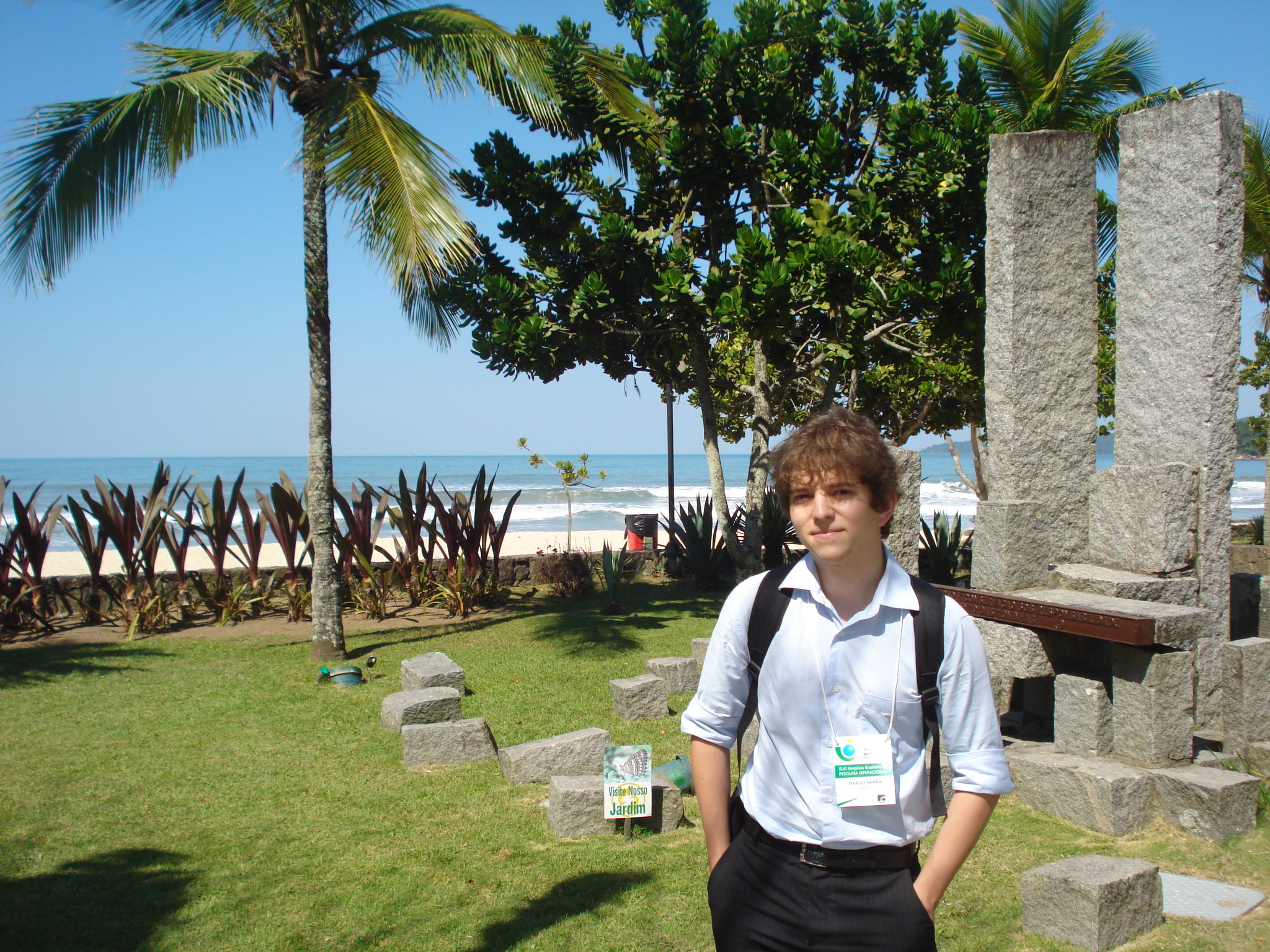
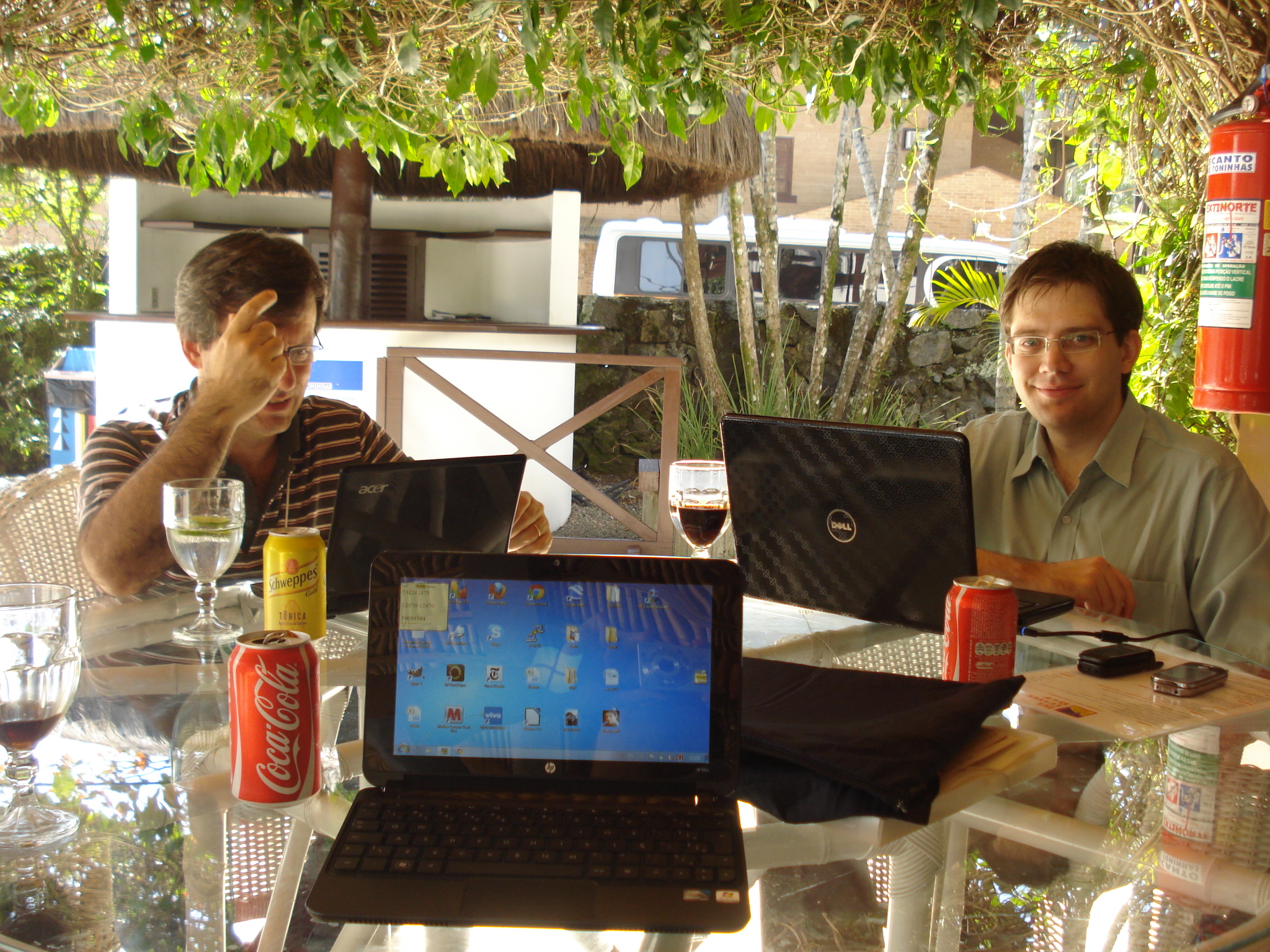
Ok, I’ve kind of stolen Tallys Yunes blog name for the post title, but I could not resist: it is winter time in Brazil but it is a sunny and hot day in Ubatuba, where the 2011 Brazilian Symposium on Operations Research (SBPO) is being held. I’ve presented my paper this morning and now I can watch the rest of the event without worrying about it at all (I love presenting earlier). In the hope to get some readers tempted to attend to the next SBPO editions, here goes some pictures of the conference hotel, the sea view and my colleagues working under extremely hard conditions:

Dsc03707
Dsc03713
Dsc03716

When Brazil excels for real (or floating point): International Olympiads in Informatics

One gold and three bronze medals out of four competitors: that would be routine for some countries, but it meant a lot to Brazil in the 2011 edition of IOI. It was the best result of the country ever, achieved after more than a decade of continuous hard working by many people, including some professors and colleagues of mine from the University of Campinas – Unicamp – and the University of São Paulo – USP – but also from many other places. Like some friends of mine, I got more proud of that result than I would be of a World Cup title.

I had the opportunity to participate on the training for selecting the Brazilian competitors for the 2003 IOI and, despite scoring very bad at that selecting contest, I left it motivated to keep studying and practicing. In the years that followed, I tried my best in the South American and the Southwest European ICPC contests and achieved a humble result of three bronze medals. But the best part of it was that I learned a lot during those five years and so did most of my colleagues that went on the same direction, building a network of professionals that indicate each other for interesting jobs.

I do not think it is very common that IT undergrads follow the path towards an OR specialization, but that happens more often among those that engage in programming contests that valuate algorithm design and implementation skills. Such contests represent a great opportunity to leverage the area in Brazil, since the training required by the new generations can be supported by a number of professors that had their abroad doctoral studies sponsored some decades ago. Despite how far we are from devising strategic plans to excel somehow, good ideas here and there (even if decades ago) and the passionate effort of great individuals are playing an important role to the development of our country.

Offshore Resources Scheduling and the Brazilian Symposium on Operations Research

On August 17th, I will present an article about what I’ve been working on my M.Sc. thesis at the Brazilian Symposium on Operations Research (shortened SBPO in Brazil). This article is authored by me and some colleagues from work. We are tackling the problem of scheduling offshore resources to develop oil wells with Constraint Programming (CP). It took a great effort to present so much about the problem and how to solve it in a way that it accessible to a broader audience (I hope we have managed to do that). There are four other papers competing for the best paper award. We will try our best there. Anyway, I’m glad by the nomination.

The 2011 SBPO will be held in Ubatuba, a beach town half-way between São Paulo and Rio de Janeiro.

When the Network becomes Social: Small World Graphs and O.R.

Mathematicians have been studying graphs for a long while. Sociologists found out that some of them explain how we interact. Indeed, social networks just make the connection more evident to anyone. In the middle of that, some researchers have been wondering about the following question: can we make optimal decisions based on our local information into a social network?

A world of lines and dots…

Dots and lines connecting pairs of dots – that’s a graph (but we usually say vertices and edges – or nodes and arcs – when talking about them). Mathematicians study graphs because they are structures capable of modeling lots of relationships among entities. Sometimes they wonder if a property found in a certain graph implies another one, developing statements to the Graph Theory. Other times they want to leverage those properties when designing an algorithm that manipulates certain types of graphs, like in Combinatorial Optimization algorithms. As a matter of fact, that is not an isolated case – many researchers handling real-world problems aim at designing algorithms with an outstanding performance for the most common instances they expect to solve.

… and the world of people!

Many people have already heard about the “six degrees of separation” principle, which states that – on average – you can reach any person in the world through a chain of six people that know one another. Such “magical number” emerged from experiments of Stanley Milgram and others during the 1960’s, in which they asked a person in the U.S. to deliver a letter to another person by submitting it to someone that he/she knew and who he/she supposed to be closer to such person. Theoretical results also point something similar: for a random graph, the average shortest distance among pairs of vertices is proportional to the logarithm of the number of vertices, what means a very slow pace of increment as graphs get bigger and bigger. However, that is not truefor any graph. Instead, people started looking to a more specific class of graphs called Small World Graphs, which are supposed to be representative of a number of situations.

Small World Graphs to be explored everywhere

Small World Graphs can be though as a combination of lattices (grids of edges) and clusters or quasi-clusters (groups in which almost all edges exist among vertices) with a small average degree (number of edges from each vertex). The former property ensures that the graph is connected and it is possible to find a path among any pair of vertices. The later has to do with the fact that two vertices sharing an edge with a third one are more likely to share an edge among them. Think about it: you might know some people from your university, almost everyone from your department, whereas each of your colleagues is more likely to have long range connections with researchers sharing a common interest worldwide; and all of that together means that you don’t need many steps to reach most of the researchers in the world. The same goes valid for airports: your local airport might be connected to a number of airports in other cities of your country and some of them are connected to airports worldwide in a way that you can attend to your meetings everywhere without worrying too much about how to get there. However, if you need to think about it, you might probably come up with a very good answer, isn’t it?

Do we always have optimal answers from local network information?

That’s the question that Jon Kleinberg tries to answer in the article “The Small-World Phenomenon: An Algorithmic Perspective”. He claims to have found the class of graphs for which such local information ensures an optimal decision. To be honest, I didn’t read the entire paper (I’m in really busy times) but it sounds really interesting and I left to the curious reader such task (let me know about it after).

This post was prompted by the INFORMS Blog Challenge of July: OR and Social Networking. You can check all the submitted entries by August 4th.

The model as a spell and the solver as a wand: O.R. magic for a muggles’ world

Who cares about O.R. magic?

When I said once to my sister that my former job was to put more fridges on each truck to save delivery trips (something that many of my colleagues consider a joyful job), she couldn´t be less interested. Maybe I should have tried to use magic metaphors to describe models as spells, solvers as wands and programming contests as Quidditch games for students. Despite those interested in profits and costs, operations research practice sounds really boring to the general audience.

Who believes in O.R. magic?

We are embedded in optimization problems that are usually overlooked. As a result, tackling one of them might look like plain witchcraft to an outsider: how come that costs were reduced by 5% or profit raised by 20% just like that? Of course that such witchcraft may need to compete with quack consultants selling a sole system supposedly capable of solving whatever problem the client has. Apart from a parcel of executives and engineers, O.R. seems to be hovering between unfamiliarity and suspicion to many, what means a lot of opportunities lost.

How to bring them in or back to OuR magic?

Paul Rubin had many insights about that: he presented a very sound analysis about “hitting muggles” on his blog to target high-level executives, business students and small organizations. Indeed, I’ve been on training classes at Petrobras along with many young economists that have been just hired and most know little but are very interested about operations research. I hope they enjoy the O.R. lectures to be held.

Nevertheless, I would like to praise for a holistic education about O.R. for engineers and IT professionals. Being so diversified, O.R. involves fields as diverse that practitioners of some are not fully aware about the existence of others that would suit their needs. Moreover, complex software systems are very likely to require O.R. at some point but system analysts and system architects might not be aware about that. In both cases, an interesting application – if not ignored – might be approached with the wrong spell or wand! Despite how much I believe in magic, I know that I’m a muggle sometimes.

Some concluding remarks about CPAIOR

CPAIOR 2011 is coming to its end. Despite not being the first international conference that I have ever been, it was the most interesting so far. Among the reasons for that is the fact that it is very focused if compared to other O.R. meetings. I had the opportunity to meet many people that I only knew as authors of papers I’ve read. I also met many young researchers like me, some of which as excited as I am on working in the industry with O.R.. Some of those people were impressed by how far I came from. As a matter of fact, with internet (and free access to articles) it is possible to be a researcher anywhere in the world, even if your country does not have a tradition on the topic you work with. However, talking to experienced people at such environments saves a lot of time and helps you getting further.

As for the organization, the Zuse Institute staff did a great job at everything. They managed to have something going on every night after the conference presentations. I wish I could attend to the informal meeting after the conference today, but I have bought tickets to leave Berlin in advance.


Which problems could a million CPUs solve? (More about CPAIOR)

I’ve just attended a presentation from Thorsten Koch entitled “Which Mixed Integer Programs could a million CPUs solve?” at CPAIOR 2011. Like any presentation of a challenging research topic would be, it has left more doubts than answers at the end of it. Let’s understand part of the rationale of that.

As many people had already noticed, the frequency of individual processors are not increasing any longer due to technological restrictions of the current technology. Instead of that, our computers are having more and more cores. Despite the performance improvement being still noticeable for a standard user which otherwise would have many different applications being handled by the same processor, having more cores does not help a single software if it is not designed to take advantage of that.

In the case of optimization applications, that can be even more dramatic, since solvers like CPLEX does a lot of processing at the root node. Koch suggests that algorithms like the Interior Points Method would gain part of the Simplex share in the future, as is the case of parallel algorithms for matrix factorization. Hence, it seems that algorithm design researchers will have an increased budget in the forthcoming years.