Summer 2019 schools on data analytics, discrete math, machine learning, networks, optimization, and other relevant topics in operations research

This post covers relevant schools happening between April and September of 2019. If you know of other schools that are not listed here, please reach out to me. Like in previous semesters, I will keep updating this post and I may add some schools with past deadlines as reference for readers looking for schools in the next years.

Previous posts: Summer 2016, Winter 2016 / 2017, Summer 2017, Winter 2017 / 2018, Summer 2018, and Winter 2018 / 2019.

PS: For schools after September, check the Winter 2019 / 2020 post

NATCOR Stochastic Modeling
April 1-5     (deadline not posted)
Lancaster, England

The Data Incubator Data Science Fellowship
April 1 – May 24     (deadline not posted)
New York / San Francisco Bay Area / Boston / Washington DC, USA, or online

Rising Stars in Computational and Data Science
(workshop for female graduate students and postdocs)
April 9-10     (deadline: January 22)
Austin, TX, USA

Complex networks: theory, methods, and applications
May 13-17     (deadline: February 17)
Como, Italy

Numerical Analysis Summer School 2019: A Numerical Introduction to Optimal Transport
May 13-17     (deadline: March 15)
Paris, France

IPCO (Integer Programming and Combinatorial Optimization) Summer School
May 20-21     (deadline not posted)
Ann Arbor, MI, USA

2019 Midwest Big Data Summer School for Early Career Researchers
May 20-23     (deadline: March 20 for early registration)
Ames, IA, USA
* Included on February 19

2nd International Summer School on Artificial Intelligence and Games
May 27-31     (deadline not posted)
New York, NY, USA

Simons Institute Workshop: Deep Learning Boot Camp
(preannouncement; details to follow)
May 28-31     (deadline not posted)
Berkeley, CA, USA

Quantum Computing Summer School Fellowship
June 3 – August 9     (deadline: January 18)
Los Alamos, NM, USA

Advanced Process Optimization: Optimization in Biochemical Processes and Practical Optimization Techniques & Tools
June 3-14     (deadline: May 30)
Lyngby, Denmark
* Included on March 11 by suggestion of Richard Oberdieck

Applied Machine Learning Summer Research Fellowship
June 6 – (10-12 weeks)     (deadline: January 3 for first round of applications)
Los Alamos, NM, USA

Numerical Computations: Theory and Algorithms (NUMTA)
June 15-21     (deadline: March 31)
Crotone, Italy

DTU CEE Summer School 2019: Data-Driven Analytics and Optimization for Energy Systems
June 16-21     (deadline: March 15)
Copenhagen, Denmark
* Included on February 19

Summer Institute in Computational Social Science
June 16-29     (deadline: February 20)
Princeton, NJ, USA

Machine Learning Crash Course (MLCC 2019)
June 17-21     (deadline: April 19)
Genova, Italy
* Included on February 19

Finite Geometry & Friends
June 17-21     (deadline not posted)
Brussels, Belgium
* Included on February 19

Summer School on Behavioural Operational Research (BOR)
June 17-21     (deadline: May 15)
Nijmegen, The Netherlands
* Included on April 22

Summer School on Geometric and Algebraic Combinatorics
June 17-28     (deadline: February 27)
Paris, France
* Included on February 19

Gene Golub SIAM Summer School 2019: High Performance Data Analytics
June 17-30     (deadline: February 8)
Aussois, France

17th Annual Wolfram Summer School
June 23 – July 12     (deadline: May 25)
Waltham, MA, USA

Applied Bayesian Statistics Summer School on “Bayesian Demography”
June 24-28     (deadline not posted)
Como, Italy

Eötvös Loránd University Summer School in Mathematics: On the crossroads of topology, geometry and algebra
June 24-28     (deadline: April 30 for early registration)
Budapest, Hungary

Mathematical Optimization of Systems Impacted by Rare, High-Impact Random Events
June 24-28     (deadline not posted)
Providence, RI, USA

Data Science Summer School (DS3)
June 24-28    (deadline: April 26)
Palaiseau, France
* Included on February 19

RISIS Summer School on Data Science for studying Science, Technology and Innovation
June 24-28     (deadline: May 26)
Glasgow, Scotland
* Included on April 30

Summer School on Computer Science
(preannouncement; details to follow)
June 24-30     (deadline not posted)
Novosibirsk, Russia

International School of Mathematics “Guido Stampacchia”: Advances in Nonsmooth Analysis and Optimization (NAO 2019)
June 24 – July 1     (deadline: May 31)
Erice, Italy
* Included on February 19

Institute for Mathematics and its Applications (IMA) Math-to-Industry Boot Camp IV
June 24 – August 2     (deadline: February 28)
Minneapolis, MN, USA
* Included on February 19

1st MINOA PhD school: Mixed-Integer Nonlinear Optimization meets Data Science
June 25-28     (deadline not posted)
Ischia, Italy
* Included on January 16 by suggestion of Andrea Lodi

9th PhD School in Discrete Mathematics
June 30 – July 6     (deadline: May 31)
Rogla, Slovenia

Swedish Summer School in Computer Science (S3CS) 2019: Information Theory in Computer Science and Spectral Graph Theory
June 30 – July 6     (deadline: March 8)
Stockholm, Sweden
* Included on February 19 by suggestion of Ludmila Glinskih

2nd Summer School on Optimization, Big Data and Applications (OBA)
June 30 – July 6     (deadline: March 15)
Veroli, Italy

Summer School on Randomness and Learning in Non-Linear Algebra
July 1-4     (deadline not posted)
Leipzig, Germany
* Included on April 22

Association for Constraint Programming (ACP) Summer School
(preannouncement; details to follow)
July 1-5     (deadline not posted)
Vienna, Austria

Latin-American Summer School in Operations Research (ELAVIO)
(preannouncement; details to follow)
July 1-5     (deadline not posted)
Lleida, Spain

NATCOR Simulation
July 1-5     (deadline not posted)
Leicestershire, England

Random Trees and Graphs Summer School
July 1-5     (deadline: May 5)
Marseille, France

Future of Computing Summer School
July 1-5     (deadline not posted)
Porto, Portugal
* Included on February 19

International Summer School on Deep Learning 2019
July 1-5     (deadline: February 28)
Gdansk, Poland
* Included on February 19

Advanced Course on AI (ACAI): AI for Multi-Agent Worlds
July 1-5     (deadline: May 15 for early registration)
Chania, Greece
* Included on March 4

Eastern European Machine Learning Summer School
July 1-6     (deadline: March 29)
Bucharest, Romania

Reinforcement Learning Summer SCOOL (RLSS)
July 1-12     (deadline: March 15)
Lille, France
* Included on February 19

Satisfiability, Satisfiability Modulo Theories, and Automated Reasoning (SAT/SMT/AR) Summer School
July 3-6     (deadline not posted)
Lisbon, Portugal
* Included on February 19

Vision Understanding and Machine Intelligence (VISUM) Summer School
July 4-12     (deadline: March 22)So
Porto, Portugal
* Included on February 19

Applications of Machine Learning and Intelligent Optimization to Tourism and Hospitality: Summer School and Workshop
July 5-9     (deadline: February 28 for regular registration)
Trento, Italy

Gdańsk Summer School of Advanced Science on Algorithms for Discrete Optimization
July 6-12     (deadline: April 30 for early registration)
Gdansk, Poland
* Included on February 19

Southeast Asia Machine Learning School (SEA MLS)
July 8-12     (deadline was April 20)
Depok, Indonesia
* Included on April 22

Nice Summer School on Random Walks and Complex Networks
July 8-19     (deadline: May 1)
Nice, France

Random Graphs and Complex Networks: Structure and Function
July 8-19     (deadline: March 27)
Como, Italy

Lisbon Machine Learning School (LxMLS)
July 11-18     (deadline: March 31)
Lisbon, Portugal

Tsinghua University 2019 Deep Learning Summer School
July 13-26     (deadline: April 15)
Beijing, China
* Included on February 19

2nd Advanced Course on Data Science & Machine Learning (ACDL 2019)
July 15-19     (deadline: March 31 for early registration)
Siena, Italy

Simons Institute Workshop: Frontiers of Deep Learning
(preannouncement; details to follow)
July 15-19     (deadline not posted)
Berkeley, CA, USA

Machine Learning Summer School 2019 – London
July 15-26     (deadline: January 31)
London, England

Choice-Based Optimization (English description here)
July 22-25     (deadline: June 17)
Hamburg, Germany
* Included on March 15 by suggestion of Sven Müller

ICSP (International Conference on Stochastic Programming) PhD School (preannouncement; details to follow)
July 22-26     (deadline not posted)
Trondheim, Norway

3rd International Summer School on Deep Learning (DeepLearn 2019)
July 22-26     (deadline: March 2 for early registration)
Warsaw, Poland
* Included on February 19

AI Summer School 2019
July 22-26     (deadline: June 3)
Singapore
* Included on May 28

Kempten International Summer School 2019: Data Science for Everyone
July 22-30     (April 30)
Kempten, Germany

Deep Learning and Reinforcement Learning (DLRL) Summer School 2019
July 24 – August 2     (deadline: February 15)
Edmonton, AB, Canada

Argonne Training Program on Extreme-Scale Computing
July 28 – August 9     (deadline: March 4)
St. Charles, IL, United States

5th Algorithmic and Enumerative Combinatorics Summer School 2019
July 29 – August 2     (deadline: June 15)
Hagenberg, Austria

ICCOPT (International Conference on Continuous Optimization) Summer School: Large Scale and PDE Constrained Optimization; Optimization and Machine Learning
August 3-4     (deadline not posted)
Berlin, Germany

Machine Learning Research School 2019
August 4-11     (deadline: May 31)
Bangkok, Thailand
* Included on May 28

Foundation of Data Science (FDS) Summer School 2019
August 5-8     (deadline: May 24)
Atlanta, GA, USA
* Included on March 4

Simons Institute Workshop: Emerging Challenges in Deep Learning
(preannouncement; details to follow)
August 5-9     (deadline not posted)
Berkeley, CA, USA

The Cornell, Maryland, Max Planck Pre-doctoral Research School 2019: Emerging Research Trends in Computer Science
August 6-11     (deadline: February 7)
Saarbrücken, Germany

Groups and Graphs, Designs and Dynamics (G2D2) Summer School
August 12-25     (deadline: March 1)
Yichang, China
* Included on February 19

Summer School on Deep Learning and Bayesian Methods (Deep|Bayes)
August 20-25     (deadline: April 15)
Moscow, Russia
* Included on February 19

Machine Learning Summer School 2019 – Moscow
August 26 – September 6     (deadline: April 5)
Moscow, Russia

EURO PhD Summer School on Operational Research for Value-based Health Care
September 1-8     (deadline: February 14)
Lisbon, Portugal

Model Guided Data Science
September 2-6     (deadline not posted)
Como, Italy

Gaussian Process and Uncertainty Quantification Summer School 2019
September 9-12     (deadline: July 1 for early registration)
Sheffield, England
* Included on May 28

NATCOR Combinatorial Optimization
September 9-13     (deadline not posted)
Southampton, England

Collective Intelligence and Big Data Revolution
(preannouncement; details to follow)
September 16-20     (deadline not posted)
Como, Italy

The 2018 Judith Liebman Awardees

(Originally posted in the INFORMS 2018 blog).

The student award reception had a special taste for me because the three winners of the Judith Liebman Award are friends that I have known for years and I witnessed their hard work towards this recognition. This is an award given to student volunteers that did excellent work on behalf of INFORMS student chapters and the Subdivisions Council.

Neda Mirzaeian arrived at Carnegie Mellon when I was starting my second term as president of the student chapter. Every time I have asked for her help, she always delivered beyond expectations. That started with our social events, then new initiatives, and she naturally rose to the presidency of our chapter. When she invited Margaret Brandeau for a talk at CMU last year, she also organized a panel entitled “Women in Academia” featuring Dr. Brandeau along with other female faculty across campus.

Lauren Steimle was the president of the student chapter at the University of Michigan and also served as the student representative in the Subdivisions Council. As a chapter president, I enthusiastically voted for her after reading her position statement, which showed to me that she had a clear vision and bright ideas to make INFORMS better for its students members.

Finally, Carlos Zetina was the driving force behind the creation and multiple initiatives developed by the Montreal Operations Research Student Chapter. MORSC encompasses several universities in Montreal, having an impressive number of members and activities, and is affiliated with both INFORMS and CORS, which is the Canadian counterpart of INFORMS.

The little engine that could generate INFORMS 2018 talks

(Originally posted in the INFORMS 2018 blog).

There are many ways to contemplate data. Shabbir Ahmed just tweeted a word cloud based on talks of the INFORMS 2018 Annual Meeting in Phoenix:

https://twitter.com/Shabbir0Ahmed/status/1058370838628630531

In this post, I will use a random walk instead. I wrote a piece of code that traverses talk titles to compute the frequency that each work is the first, the last, or the immediate successor of another word. This Markovian model can easily generate random titles but it is arguably not state-of-art, so why not using something more ellaborate like an LSTM? I wanted something complex enough to make sense while simple enough to generate unexpected outcomes. Otherwise, it would be boring to read them!

I believe that I can roughly classify the results that I got in four categories, which by decreasing frequency are the following:

  1. Non-sense.
  2. Awkward or boring statements.
  3. Long titles mixing the most commonly used terms (see “The buzzword bingo”).
  4. Somewhat plausible but unexpected titles (see “The interesting talks you will not see at INFORMS”).

The interesting talks you will not see at INFORMS

These are the types of talks that I am looking for when I arrive every year:

  • A Spatial Branch-and-Bound Algorithm via Retrospective Study
  • A Vehicle Routing Problem Becomes My Dishwasher: Selective, Manufacturing
  • Active Surveillance Monitoring of Large SDPs
  • Ambulance Emergency Response by a Social Media Network Component
  • An Integrated Train Timetabling Using Social Networks
  • An Optimization Competition in Retail: Evidence from Conflict Constraints and Implications
  • Asymptotic Optimality and International Gold Price, a Dual Reoptimization
  • Expanding a Dual is Less Irritating: Inducing Fresh Produce Supply Chain Management Science
  • Grounding Frequent Flyers: A Constraint
  • Managing the Expected Utility Models for More Sustainable, Swimming and Energy Bilateral Ratings in Bike Sharing
  • Optimal Cooperative Game: A Machine Learning Teaching Analytics Modeling and Improvement Projects
  • Optimal Solutions Revisited: The Impact Of Nonlinear Programs for Resource Allocation in Dynamic Decentralized Customization With 3d Printing
  • Optimizing Faculty Summer Research on Alibaba
  • Person Name Detection Using the Mean Field ExperimentalEvidence from Bike-sharing Economy on Different Textual Components
  • Predicting and Working Harder: The Impact on Modularization Design for the Optimal Steady State of Repairable Spare Parts Networks
  • Risk-sharing Agreements for Strongly Convex Risk Management in Platforms
  • Robust Contingency Constrained Optimization of Autonomous Driving: Can Voluntary Time-of-use Tariffs be Recommended?
  • Stochastic Analysis of Semidefinite Optimization
  • Stochastic Programming of Relativity
  • Triple-bottom-line Approach to Identify Smoking Status

The buzzword bingo

When the conference is over and I get overwhelmed, this is roughly what I recollect:

  • A Branch-and-price Algorithm for Fault Diagnosis for Using Data Analytics to Preferred Boarding Patients with Reusable Products in Hospitals? Evidence from an Urban Function Selection Under Competition in a Newsvendor Analysis of Gaussians via Accelerated Minibatch Coordinate Descent
  • A Bilevel Framework for Liver Exchange Intelligence and Morel Hazard
  • A Minimum Cost of First-order Optimization for Stochastic Mixed-integer Recourse via Machine Learning
  • A New Algorithm for the FEMA National Airspace Operations Training System Performance in a Medical Knowledge Gradient Descent Method for Extending Drone Assisted Devices and Water Distribution Networks
  • A Novel, Depth, Mixed-integer Programming Approach to Speculate on Hospitals’ Risk Analysis in Hydropower Plants Using Probability Dominance Information Asymmetry and Supply Chain Choice Model for Resources in Humanitarian Supply Chain Performance Trade-offs when Customers
  • Appointment Scheduling of Wind Along the Use of Outliers: Market Sensing from Digital Gamification Systems for Mislabeled Classification for Machine Learning
  • Blockchain Adoption in Continuous-time Markov Decision Making Economic Assessment for New Product Perishability
  • Blockchain can Increase Value of Doubly Stochastic Gradient Descent: A Machine Learning
  • Conditional Gradient Method of Customer Churn Prediction in Online Experiments on Multi-agent Based on Retail: Evidence from Bike-sharing Systems via Uncertainty
  • Dynamic Integer Programming Approach to Robust PCA by Eliminating Payment Models
  • Dual Bounds for Reinforcement Learning Heuristics to AC Optimal Power and Firm Innovation
  • Efficient Computational General Equilibrium Models for theTraveling Salesman Problem for Network Flow Control of Hospital Waiting Time Delay in Matlab
  • Healthcare Plan for the Use of Renewable Electricity and How Frequent Flyers Choose Their Affiliates
  • Lift-and-project Lower Bounds for the Heterogeneous Marginal Price Optimization in Bangladesh: An Empirical Analysis of Innovation in the Service
  • Mothership and Efficiency Investment in Construction of the Gig Economy Workers
  • Optimal Service Plan Model for High Dimensional Covariates and Quality in What We Forget About Blockchain Technology
  • Queueing Design using the Strongest Influence of Personalized Advertising
  • Realizing the Participatory Exploratory Modelling the Hitchcock- Koopmans Problem Solving Generalizations of an Academic Science at the Boston Public Transportation Platform Selection using Discrete Probability Computation of B2C E-commerce Age of Gamification on Detour Distances
  • Second-order Decomposition for Large-scale P2P Ride-Hailing Networks
  • Social Media Network Using Bilevel Mixed-integer Recourse Strategies: Facilitate P2P Platform ? Evidence from Ford

Wrapping up

It will be no surprise if you found two or three consecutive words above that you used for your talk. To the best that I could, I tried avoiding examples that were too similar to any of the talks in the program. I hope that I managed to keep it that way.

Now, why did I call this piece of code an engine? Marketability! The following tweet is from a talk by Rama Ramakrishnan at a seminar in the MIT Operations Research Center:

Last but not least, INFORMS made my life a lot easier by sending me the data I needed. Special thanks to Mary Leszczynski!

Winter 2018 / 2019 schools on algorithms, big data, data science, discrete math, optimization, and other relevant #orms topics

If you know of other schools that are not listed here, please reach out to me. Like in previous semesters (Summer 2016, Winter 2016 / 2017, Summer 2017, Winter 2017 / 2018, and Summer 2018), I will keep updating this post and I may add some schools with past deadlines as reference for readers looking for schools in the next years.

IWR School “Advances in Mathematical Optimization”
October 8-12     (deadline: August 31)
Heidelberg, Germany

International Colloquium on Theoretical Aspects of Computing (ICTAC) Spring School
October 12-15     (deadline: September 12 for early registration)
Stellenbosch, South Africa
* Included on September 4

COIN fORgery: Developing Open Source Tools for Operations Research
October 15-19     (deadline not posted)
Minneapolis, MN, USA
* Included on August 27 by suggestion of David Bernal

First Nepal AI Winter School 2018
December 20-30     (deadline: November 15)
Kathmandu, Nepal
* Included on October 14

5th International Winter School on Big Data
January 7-11     (deadline: September 18 for early registration)
Cambridge, UK

14th Summer School on Discrete Math
January 7-11     (deadline: September 28)
Valparaiso, Chile

2019 Grid Science Winter School & Conference
January 7-11     (deadline: October 30 for student sponsorship)
Santa Fe, NW, USA
* Included on October 11 by suggestion of Hassan Hijazi

The Data Incubator Data Science Fellowship
January 7 – March 1     (deadline not posted)
New York / Bay Area / Boston / DC, USA -– or online

Winter School on Optimization and Operations Research
January 13-18     (no deadline posted)
Zinal, Switzerland

2019 Data61 International Optimisation Summer School
January 13-18     (deadline not posted)
Kioloa, Australia
* Included on September 17

AMS Short Course on Sum of Squares: Theory and Applications
January 14-15     (deadline: December 27 for early registration)
Baltimore, MD, USA
* Included on October 2

8th Winter School on Network Optimization
January 14-18     (deadline: October 31 – submit CVs to NetOpt2019@fc.ul.pt)
Estoril, Portugal

HUMAINT Winter school on AI: ethical, social, legal and economic impact
February 4-8     (deadline: November 1)
Seville, Spain

Winter School on Theoretical Foundations of Computer Science
February 4-9     (deadline: December 15 for early registration)
Tbilisi, Georgia
* Included on October 31

The Power of Algorithms? A Sociological Perspective
February 7-15     (deadline: September 1)
Würzburg, Germany

Spring School and Workshop on Polytopes
March 11-15     (deadline: January 7 for contributed talk; February 11 otherwise)
Bochum, Germany
* Included on October 22

3rd AIROYoung Workshop + PhD School “Advanced Methods in Optimization and Data Science”
March 26-29     (deadline not posted)
Rome, Italy
* Included on October 11; updated on January 24

Some highlights on Madison’s IFDS summer school: Randomized linear algebra, active machine learning, random graphs (and, of course, deep learning)

I had a great time last week attending the summer school on Fundamentals of Data Analysis at UW-Madison. You can find more details on the school’s website, which might probably get updated with recordings of the talks at some point, and also searching for tweets with the hashtag #MadisonDataSS. Three courses introduced me to very interesting topics and the concluding deep learning lab was a blast.

This post mixes some of my tweets with additional comments on those subjects.

Randomized Linear Algebra

This course started with estimating the product of very large matrices by using a sample of rows or columns. I left wondering that one could do something similar for linear programs with too many variables or constraints, and estimate the value of the optimal value. Then Jeff Linderoth told me that Leo Liberti has done exactly that with some collaborators: there is a pre-print at Optimization Online.

Active Machine Learning

This judicious choice of data points to calibrate the model in active learning is important when there is a cost associated with labeling those points. For example, when you need human intervention to determine what the label should be.

Random Graphs

The tweet above about graph clustering was one of those memorable moments when my jaw dropped during a lecture. And those were just 3 slides!

Deep Learning

The jupyter notebooks of this lab take a bit longer than the lecture time, and I have yet to finish them, but they have been quite easy to follow on my own.

The rational fear of irrational coefficients: Talking about IP on PI day

One of the central elements of (Mixed-) Integer Linear Programming is the polyhedral approach. The feasible set of a Linear Program is a polyhedron, where a vertex (if there is one) is optimal for any linear objective function where an optimal solution exists. In the case of MILPs, however, the integrality constraint on some variables breaks down the feasible set S into disjoint polyhedra. Nevertheless, the first reasonable attempt at solving any MILP consists of replacing S with the linear relaxation P defined by the linear constraints of the formulation alone. Then we can run the “wish-me-luck” algorithm:

The wish-me-luck algorithm:
1.     Ignore the integrality constraints and solve the MILP as an LP.
2.     If the integrality constraints are satisfied, we are done!
3.     Otherwise, we are (temporarily) doomed!

DSC09669bSometimes the gamble is guaranteed. If we can find a polyhedron Q corresponding to the convex hull of the feasible set S, i.e. Q = conv(S), then we can solve the MILP as if it were an LP by optimizing over Q because all vertices belong to S. We say that an MILP formulation is perfect if P and Q coincide, like in network flow problems with integer coefficients. In the vast amount of cases where that does not happen, the quest illustrated in Schrijver’s book cover begins: we want to start from a good P (in white) and hopefully find an optimal solution by getting closer to Q (in red).
For a good P, we may compare different formulations for their strength. For example, by showing that the linear relaxation of one formulation is a proper subset of another, even if  the variables are different. We can show that by proving that a function maps each solution of the linear relaxation of one formulation to that of another whereas the converse is not true. To strengthen this formulation towards something like Q, at least around the optimal solution, we may add cutting planes. A cutting plane is an inequality that removes a region of the linear relaxation not in S, which is often around an optimal solution of the linear relaxation, in the hope that “wish-me-luck” works next time!

We take for granted that the convex hull is polyhedral, but is it? The following result is adapted from the recent book by Conforti, Cornuéjols, and Zambelli:

The Fundamental Theorem of Integer Programming (Meyer, 1974):
Given rational matrices A, G and a rational vector b, let P := { (x, y) : Ax + Gy ≤ b } and let S := { (x, y) ∈ P : x integral }. Then there exist rational matrices A’, G’ and a rational vector b’ such that conv(S) = { (x, y) : A’ x + G’ y ≤ b’ }.

The fact that the coefficients of the formulation should be rational is often overlooked. In practice, since these problems are solved with finite precision, this becomes irrelevant. However, the convex hull of some MILPs is not polyhedral. The following example is adapted from an exercise in the book above and includes “pi” as a special guest.

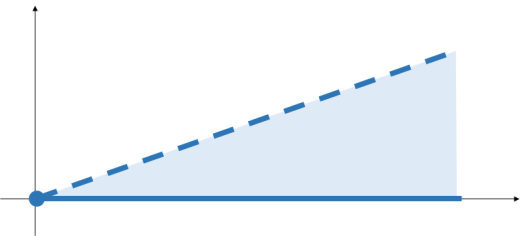
If P := { (x, y) : 0 ≤ y ≤ π x } and S := { (x, y) ∈ P : x, y integral },
then conv(S) = { (0, 0) } ∪ { (x, y) : 0 ≤ y < π x }, which is not polyhedral.

pi

The proof for this example is quite simple (in comparison to the example in CCZ’s book). First, no point besides (0, 0) in the line y = π x belongs to S, and by consequence to conv(S). Suppose for contradiction that such a point (x’, y’) exits. Then y’ / x’ is a rational representation of π, a contradiction.  Second, any other point (x, y) for which 0 ≤ y < π x belongs to conv(S). Since x > 0, there is a rational number p / q such that y / x < p / q < π  and thus (x, y) is inside a cone rooted at (0, 0) with rays (1, 0) and (p, q).

Hence, when it comes to integer programming, you should better be rational…

Using the CPLEX solver through COIN-OR’s Open Solver Interface

Today I could not find a single web search result for this:

OsiCpxSolverInterface.hpp: No such file or directory

If you come across this error, you are likely trying to compile code that uses COIN-OR software but that, ultimately, relies on CPLEX to solve optimization problems. In my case, that software was CBC and I reinstalled it (i.e., ./configure; make; make install) with the path to CPLEX libraries and headers on my computer. There is a good explanation for configure options in COIN-OR’s website, but I also needed to add some additional library compiler flags to make it work. So here is my configure command in the end:

./configure –with-cplex-lib=”-L/opt/ibm/ILOG/CPLEX_Studio1263/cplex/lib/x86-64_linux/static_pic/ -lcplex -lpthread -lm” -with-cplex-incdir=”/opt/ibm/ILOG/CPLEX_Studio1263/cplex/include/ilcplex”

If you came here with the same problem, I hope this post saves you some time  🙂

Summer 2018 schools on algorithms, combinatorics, data science, machine learning, optimization, and other relevant #orms topics

If you know of other schools that are not listed here, please let me know. Like in previous posts (Summer 2016, Winter 2016/ 2017, Summer 2017, and Winter 2017 / 2018), I may add schools with past deadlines as reference for readers looking for schools in the next years.

PS: For schools after September, check the Winter 2018 / 2019 post

NATCOR Heuristics & Approximation Algorithms
April 9-13     (deadline not posted)
Nottingham, England

International Spring School on High Performance Computing
April 23-27     (deadline: February 12)
San Sebastián, Spain
* Included on January 29

Optimal Transport: Numerical Methods and Applications
May 7-11     (deadline: March 10)
Como, Italy

International Spring School on Integrated Operational Problems
May 14-16     (deadline: March 31)
Troyes, France

Complex Networks: Theory, Methods, and Applications
May 14-18     (deadline: February 18)
Como, Italy
* Included on February 19

Summer School on Mathematics in Imaging Science
May 28 – June 1     (deadline: February 14)
Bologna, Italy

1st International Summer School on Artificial Intelligence and Games
May 28 – June 1     (deadline: January 31 for early registration)
Chania, Greece
* Included on January 29

VeRoLog PhD School on Vehicle Routing Problems
June 1-2     (deadline: January 31)
Cagliari, Italy

NATCOR Convex Optimization
June 4-8     (deadline not posted)
Edinburgh, Scotland

Association for Constraint Programming (ACP) Summer School 2018
June 4-8     (deadline not posted)
Jackson, WY, USA
* Included on February 19 by suggestion of Serdar Kadioglu

School on Graph Theory
June 11-15     (deadline: May 4 for early registration)
Sète, France
* Included on March 5

8th Lisbon Machine Learning School
June 14-21     (deadline: March 16)
Lisbon, Portugal

Summer Institute in Computational Social Science
June 17-30     (deadline: February 19)
Durham, North Carolina, USA

2018 Gene Golub SIAM Summer School on Inverse Problems: Systematic Integration of Data with Models under Uncertainty
June 17-30     (deadline: February 1)
Breckenridge, Colorado, USA

2nd International Workshop on Bilevel Programming (including mini-courses)
June 18-22     (deadline: April 15 for early registration)
Lille, France

Machine Learning Summer School
June 18-30     (deadline: February 20)
Buenos Aires, Argentina

The Data Incubator Data Science Fellowship
June 18 – August 10     (deadline not posted)
New York / San Francisco Bay Area / Seattle / Boston / Washington DC, USA, or online
* Included on January 29 by suggestion of Heitor H. Arakawa

International Conference on Automated Planning and Scheduling (ICAPS) Summer School
June 24-29     (deadline: March 23)
Delft, The Netherlands

DTU CEE Summer School 2018: Modern Optimization in Energy
June 24-29     (deadline: March 18)
Copenhagen, Denmark
* Included on February 2 by suggestion of Nicola Secomandi

Eötvös Loránd University Summer School in Mathematics: Introduction to Graph Limits
June 25-29     (deadline: April 30 for early registration)
Budapest, Hungary

2018 Summer School on “Operations Research and Machine Learning”
June 25-29     (registrations closed)
Fréjus, France

Summer School on Hyperbolic Polynomials, Sums of Squares and Optimization
June 25-29     (deadline: April 1)
Atlanta, GA, USA
* Included on February 19

15th International Conference on the Integration of Constraint Programming, Artificial Intelligence, and Operations Research (CPAIOR) Master Class
June 26     (deadline not posted)
Delft, The Netherlands
* Included on January 29 by suggestion of Willem-Jan van Hoeve

The Second Annual JuMP-dev Workshop
June 27-29     (deadline not posted)
Bordeaux, France
* Included on February 5

2nd School on Foundations of Programming and Software Systems: Logic and Learning
July 1-6     (deadline: April 15 for early registration)
Oxford, UK
* Included on March 22

EURO PhD School on Sustainable Supply Chains 2018 (preannouncement link)
July 1-7     (deadline not posted)
Wageningen & Amsterdam, The Netherlands

8th PhD School in Discrete Mathematics
July 1-7     (deadline: June 10)
Rogla, Slovenia
* Included on February 28

NATCOR System Dynamics
July 2-4     (deadline not posted)
Coventry, England

Summer School on Algorithms and Lower Bounds 2018
July 6-9     (deadline: April 15)
Prague, Czech Republic
* Included on February 2

ACM Special Interest Group on Genetic and Evolutionary Computation (SIGEVO) Summer School (website under construction)
July 13-19     (deadline not posted)
Kyoto, Japan

Prague School on Discrete Mathematics 2018
July 16-20     (deadline: March 30)
Prague, Czech Republic

Metaheuristics Summer School
July 21-25     (deadline: April 15)
Taormina, Italy

2nd International Summer School on Deep Learning 2018
July 23-27     (first deadline: February 14)
Genova, Italy
* Included on January 29

EURO PhD Summer School on MCDA/M (Multiple Criteria Decision Aiding / Making)
July 23 – August 3     (deadline: January 31)
Chania, Greece

8th Summer School on Imprecise Probabilities: Theory and Applications
July 24-28     (deadline: March 31)
Oviedo, Spain

Fundamentals of Data Analysis TRIPODS Madison Summer School 2018
July 24-28     (deadline not posted)
Madison, WI, USA
* Included on March 10

Deep Learning and Reinforcement Learning Summer School 2018
July 25 – August 3     (deadline not posted)
Toronto, ON, Canada
* Included on February 19

Argonne Training Program on Extreme-Scale Computing
July 29 – August 10     (deadline: February 28)
St. Charles, IL, United States

4th Algorithmic and Enumerative Combinatorics Summer School 2018
July 30 – August 3     (deadline: June 15)
Hagenberg, Austria

The Cornell, Maryland, Max Planck Pre-doctoral Research School 2018: “Emerging Trends in Computer Science”
August 7-12     (deadline: February 7)
Saarbrücken, Germany

Uncertainty Quantification Summer School
August 8-10     (deadline not posted)
Los Angeles, CA, USA
* Included on May 15

DIMACS/TRIPODS/MOPTA Summer School
August 10-12     (registration closed)
Bethlehem, PA, USA
* Included on May 15

Hausdorff School on Combinatorial Optimization
August 20-24     (deadline: April 30)
Bonn, Germany

Network Modeling for Epidemics
August 20-24     (deadline: May 1)
Seattle, WA, USA
* Included on March 12 by suggestion of Emily Tucker

SYNERGY Summer School on Efficient Multi-Objective Optimisation
August 27-31     (deadline: May 31 for early registration)
Ljubljana, Slovenia

Summer School on Statistical Relational Artificial Intelligence
August 27-31     (deadline not posted)
Ferrara, Italy
* Included on April 13

Data Science Summer School
August 28 – September 1     (deadline: April 20)
Paris, France

CPSE Summer School 2018: Optimisation Under Uncertainty
September 3-7     (deadline: July 31 for early registration)
London, England
* Included on May 18

ALOP Summer School on Mixed-Integer Nonlinear Programming
August 13-16 September 10-12 (deadline: May 30 June 15 for travel support application)
Trier, Germany
* Included on May 15, updated on June 12

FoMICS-DADSi Summer School on Data Assimilation
September 11-15     (deadline: June 30 for abstract submission)
Lugano, Switzerland
* Included on June 12

Fall School: Order and Geometry
September 14-17     (deadline: July 31)
Sauen, Germany
* Included on June 12

Graph Drawing 2018 PhD School: Recent trends in Graph Drawing and Network Visualization
September 24-25     (deadline: August 28 for early registration)
Barcelona, Spain
* Included on June 12

NATCOR Forecasting & Predictive Analytics
September 24-26     (deadline not posted)
Lancaster, England

Summer School in Algebraic Statistics
September 24-28     (deadline: June 30 for room application and/or travel support)
Tromsø, Norway
* Included on June 12

How can INFORMS help with your educational needs?

(Originally posted in the INFORMS 2017 blog).

Jill Wilson, the VP for Education, lead the first meeting of the newly created Education Strategy Committe this morning. The goal of this committe is to oversee the activities of the other education committes and think strategically about how our efforts are supporting INFORMS goals.

Do you have any ideas about information or resources that INFORMS could help develop or centralize?

Do you have suggestions for initiatives that INFORMS could support in order to promote better educational practices in Operations Research, Management Science, and Advanced Analytics?

Is there anything that we currently do, but that could be done better somehow?

I am serving as the student member of the committe and I am looking forward to know what other students think on the topic. As TAs, first-time instructors, and potentially future faculty, our input is crucial for better educating the next generation of analytics professionals.

Teaching Colloquium: The Brave 16

(Originally posted in the INFORMS 2017 blog).

In the words of one of the combined colloquia organizers, I was one of the “brave 16” yesterday. The teaching colloquium is often the smallest in attendance numbers, but also the only one that you can attend more than once. If you enjoyed attending other colloquia in the past, and deep inside you know that you have fun teaching, consider joining us next year!

You can find my longer post about what happens at the teaching colloquium in the 2016’s blog.